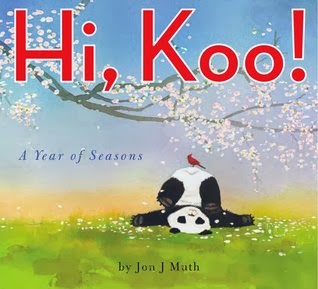
Hi, Koo! A Year of Seasons
by Jon J Muth
Call # J811.54 Muth
When
Muth created the panda Koo, he was a genius. Not only is the little
fluff ball adorable, but his name lends itself as a perfect play on
words. (Though, now that I really think about it, if someone were to say
"Hi, Koo!" they would probably be in China were pandas are found, not
in Japan were haikus originated... details, details!) Koo goes on a
poetic journey through the four seasons, exploring the soft watercolors
of autumn, winter, spring, and summer with his friends. As an added
bonous, each page/haiku has one capitalized letter, following the
alphabet pattern.
This
book actually surprised me. As a Professional Writing Major, I was
forced to take a poetry class, and while I'm not a huge fan of most
poetry, I did enjoy learning the 5-7-5 of haikus. Muth provides a nice
(and much needed) note at the beginning of the book, explaining that
while the 5-7-5 on (pronounced OWN) works in the Japanese language, it
does not always translate to an English 5-7-5 syllable count. In fact,
the importance of the haiku is not so much the form, but it's ability to
portray an entire scene (and all the emotions associated with that
scene) in three short lines.
Even
though this book "broke" my beloved 5-7-5 rule, it definitely expresses
each scene beautifully. I would recommend this book to any patron in
the children's department. Most students learn about poetry at some
point in their education, and this book is a clear way to show true
haikus. For younger kids who are only interested in the panda and his
story, the rythym of the haikus make this a fun story to read aloud.
Other books with Koo in them are Zen Shorts (a Caldecott Honor Book), Zen Ties, and Zen Ghosts (all three of which I look forward to reading!).
Other read-alikes according to Novelist are: Firefly July by Melissa Sweet, Guyko by Bob Raczka, and Today and Today, a collection of haikus by the Japanese master, Issa Kobayashi.


No comments:
Post a Comment